

Electric Traction Motor Market Share Estimated USD 41.25 Billion, at a CAGR of 9.3% During 2026 To 2035
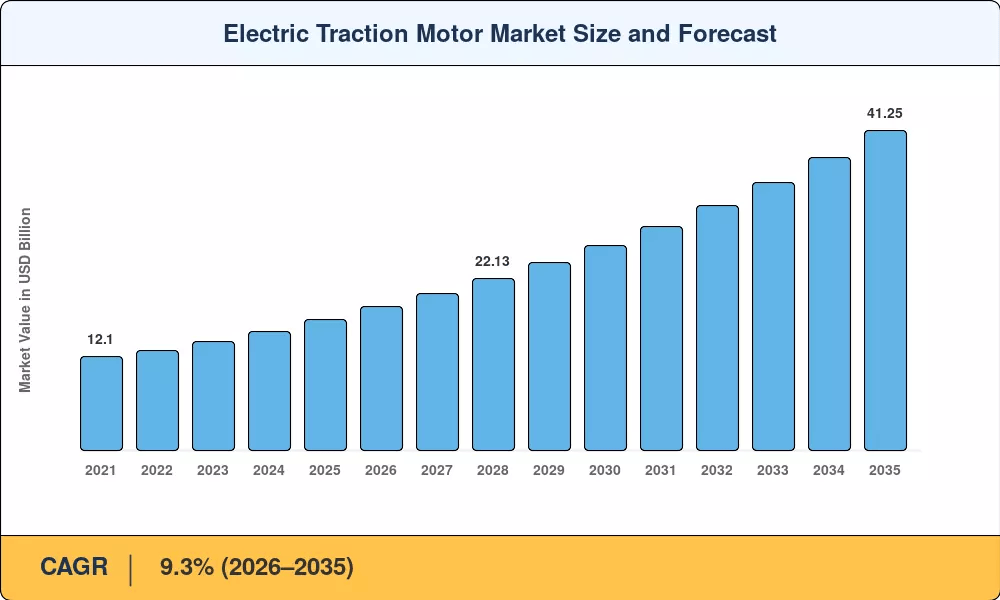
Electric Traction Motor Market Summary
Railways accounted for a 43% share of the Electric Traction Motor Market in 2025, supported by multi-billion-dollar procurement cycles in Asia and Europe.
Alternating-current motors captured approximately 61% of the Electric Traction Motor Market revenue in 2025, reflecting their dominance across rail and automotive platforms.”
NY, CA, UNITED STATES, July 15, 2026 /EINPresswire.com/ -- Electric traction motors are specialized electric motors designed to provide propulsion power for vehicles and machinery, converting electrical energy into mechanical energy to drive wheels or other moving components. These motors are critical components in railway locomotives, electric vehicles (EVs), trams, trolleybuses, and various industrial applications requiring high torque and efficient power conversion.— Arti Dhapte
Electric Traction Motor Market Overview
The Electric Traction Motor Market share stood at USD 16.95 Billion in 2025 and is projected to reach USD 18.53 Billion by 2026, climbing to USD 41.25 Billion by 2035 at a compound annual growth rate of 9.3% during the forecast period (2026–2035). Government-backed rail modernization programs across India, China, and Southeast Asia have unlocked procurement pipelines worth tens of billions of dollars, while the transition to 800-volt battery architectures in passenger vehicles is pulling automakers toward higher-efficiency propulsion units. These twin catalysts anchor a growth trajectory that outpaces broader industrial motor spending by a wide margin.
The market is experiencing robust growth driven by several key factors. The global push for railway electrification, particularly in Asia-Pacific and Europe, has created sustained demand for high-performance traction motors. China's State Council has earmarked over USD 120 billion for rail infrastructure through 2030, with roughly 35% dedicated to electrified high-speed and intercity lines. India's Ministry of Railways has electrified more than 90% of broad-gauge track as of 2025 and plans to electrify the remaining segments under Mission Raftar.
The rapid adoption of electric vehicles worldwide is another primary driver. Global BEV sales are projected to surpass 30 million units annually by 2030, creating massive demand for automotive traction motors. The shift from 400V to 800V electrical architectures in battery electric vehicles has reshaped motor specifications, enabling higher efficiency and reduced weight.
Industry trends indicate a significant technology shift from legacy wound-rotor induction designs to advanced alternating-current configurations that deliver higher torque density per kilogram. Permanent magnet synchronous motors are gaining prominence in both rail and automotive applications due to their superior efficiency and power-to-weight ratios. The European Union's revised Energy Efficiency Directive now mandates IE4-class minimum standards for new rolling stock traction chains, compelling operators to accelerate fleet renewal.
Technological developments are reshaping the market landscape. Silicon-carbide power electronics are enabling designers to shrink motor housings without sacrificing sustained output above 300 kilowatts. Integrated e-axle platforms combining motor, inverter, and reduction gear into a single housing are gaining traction in commercial vehicle applications. Digital twin technology and predictive maintenance capabilities are extending asset life and creating new service revenue streams.
Policy and regulatory influence continues to shape market dynamics. The Bipartisan Infrastructure Law's USD 66 billion passenger rail allocation is driving fresh momentum in North America. India's production-linked incentive scheme for rolling-stock components has attracted over USD 1.2 billion in committed factory investment. The EU's Fit for 55 package reinforces decarbonization trajectories by tightening CO₂ standards for both rail and road freight.
Asia-Pacific commands roughly 46% of the electric traction motor market, underpinned by China's 14th Five-Year Plan rail investments and India's National Rail Plan targeting full electrification by 2030. Europe follows as the second-largest region at approximately 24% share, driven by stringent emissions mandates and cross-border high-speed rail corridors. North America accounts for about 18% of global demand.
Get Free Sample Report for Detailed Market Insights:
https://www.marketresearchfuture.com/sample_request/7002
Electric Traction Motor Market Segmentation
By Type
Alternating Current (AC) Motors: Captured approximately 61% of market revenue in 2025, dominating both rail and automotive platforms due to superior power density, lower maintenance requirements, and compatibility with variable-frequency drive inverters
Direct Current (DC) Motors: Continue to serve legacy metro and mining applications, retaining relevance where simple speed-control characteristics and rugged construction outweigh efficiency disadvantages
By Application
Railway: Accounted for a 43% share of the market in 2025, supported by multi-billion-dollar procurement cycles in Asia and Europe
Electric Vehicle: Advancing at a projected 17.0% CAGR through 2035, the fastest among all application segments as global BEV production ramps
Others: Includes marine propulsion, mining haul trucks, and industrial applications
By Cooling Method
Air-Cooled: Led with 55% share due to simplicity and lower system cost, default choice for metro trainsets, light-rail vehicles, and sub-150 kW automotive applications
Liquid-Cooled: Fastest-growing segment at 12.1% CAGR, gaining ground as high-power applications demand sustained output above 300 kW without thermal derating
Self-Ventilated: Serves industrial traction and auxiliary drives
By Power Rating
Below 200 kW: Accounted for 51% share, driven by passenger BEVs and light metro systems
200 to 400 kW: Growing at 11.2% CAGR for high-speed EMUs and commercial trucks
Above 400 kW: Valued at USD 2.71 billion in 2025 for freight locomotives and heavy industrial applications
By Voltage Class
Below 1 kV: Fastest-growing segment at 11.3% CAGR, driven by automotive traction applications at 400V and 800V bus levels
1 to 3 kV: Commands 47% share, mirroring prevalence of 1.5 kV and 3 kV DC catenary systems in urban and suburban rail networks
Above 3 kV: Valued at USD 2.54 billion, serving mainline freight and high-speed rail
You can buy this market report at:
https://www.marketresearchfuture.com/checkout?currency=one_user-USD&report_id=7002
Electric Traction Motor Market Regional Analysis
Asia-Pacific
Asia-Pacific dominates the electric traction motor market with approximately 46% global share and is forecast to grow at a 10.6% CAGR through 2035. China leads with 52% of regional share, driven by CR450 high-speed rail investments and BYD/NIO motor integration. India posts the fastest regional growth at 12.3% CAGR, with the Vande Bharat express train network expanding and domestic motor production under Make in India. Japan's established supply chain, led by Toshiba and Mitsubishi Electric, serves both domestic Shinkansen upgrades and export markets. Southeast Asian nations are investing heavily in urban rail expansion, including Jakarta's MRT Phase 2 and Bangkok's Orange Line.
Europe
Europe holds approximately 24% market share, reflecting decades of electrified rail infrastructure combined with aggressive decarbonization targets. Germany accounts for 28% of regional share with Deutsche Bahn planning to procure over 2,000 new electric multiple units by 2032. The UK's Great British Railways reform and HS2 procurement drive an 8.6% CAGR. France's SNCF has placed orders for 115 TGV-M high-speed trainsets, each carrying eight traction motors rated above 500 kW. The EU's Connecting Europe Facility rail grants and Fit for 55 package reinforce this trajectory.
North America
North America accounts for about 18% of global demand with fresh momentum from the Bipartisan Infrastructure Law's USD 66 billion passenger rail allocation. The United States contributes 72% of regional share, driven by Amtrak NEC modernization and EV OEM motor sourcing. Canada's light-rail transit builds in Calgary and Toronto support an 8.7% CAGR. Mexico's Tren Maya project and industrial freight electrification represent emerging opportunities valued at USD 0.21 billion in 2025.
Rest of the World
South America, led by Brazil with 58% regional share, is expanding through São Paulo's metro expansion and domestic production by WEG S.A. The Middle East & Africa presents the highest greenfield opportunity density, with Saudi Arabia's Riyadh Metro representing one of the largest single urban transit procurements globally. South Africa's Transnet fleet renewal and battery-electric haul trucks in Sub-Saharan mining add industrial diversification.
Electric Traction Motor Market Competitive Landscape
The electric traction motor market exhibits medium concentration, with the top five suppliers accounting for an estimated 38-45% of global revenue. Competition is intensifying as automotive OEMs bring motor production in-house, compressing margins for traditional Tier-1 suppliers.
ABB Ltd. (~8-11% revenue share): Offers broad rail traction motors (100-600 kW) and integrated drives with strong rail installed base globally.
Siemens AG (~7-10%): Features Simotics traction series and high-speed rail motors, positioned as a technology leader with EU rail incumbency.
CRRC Corporation (~7-9%): Provides full-range rail traction from metro to freight, leveraging scale leadership and Chinese domestic dominance.
Toshiba Corporation (~5-8%): Supplies SCiB-compatible EV motors and Shinkansen traction, with deep Japan rail integration and an EV pivot.
Nidec Corporation (~5-7%): Specializes in automotive e-axle motors and 200 kW BEV platforms, pursuing aggressive automotive expansion.
Other notable players include Mitsubishi Electric, Hitachi Ltd., WEG S.A., Robert Bosch GmbH, and BorgWarner Inc. Recent developments include Nidec's USD 500 million e-axle plant in Serbia, ABB's USD 180 million framework agreement with Indian Railways, and BorgWarner's launch of a next-generation HVH 320 traction motor with integrated SiC inverter.
Latest Industry News & Developments
Siemens Mobility (March 2025): Delivered the 1,000th Vectron locomotive equipped with the company's latest AC traction motor platform, reinforcing its position as Europe's leading rail traction supplier.
CRRC Zhuzhou (January 2025): Unveiled a 690 kW permanent-magnet traction motor designed for the CR450 high-speed train platform, targeting a top operational speed of 400 km/h.
Nidec Corporation (November 2024): Broke ground on a USD 500 million e-axle and traction motor plant in Serbia, aiming for 500,000-unit annual capacity by 2028.
European Commission (February 2024): Published revised technical specifications for interoperability mandating IE4-class minimum efficiency for all new traction motors deployed on the trans-European rail network, effective January 2026.
Electric Traction Motor Market Challenges & Opportunities
Key Restraints
Rare-earth magnet price volatility presents a significant challenge, with neodymium prices swinging by as much as 40% within a single calendar year. Roughly 85% of global rare-earth oxide separation still occurs in China, creating procurement risk. Thermal management above 400 kW becomes a binding constraint, requiring expensive and unproven direct oil-spray cooling solutions. Uneven rail procurement cycles in South America and the Middle East create demand volatility that discourages local manufacturing investment. Slow scaling of rare-earth recycling limits supply diversification.
Emerging Opportunities
Integrated e-axle platforms for commercial vehicles represent a new addressable segment, with Daimler Truck and Volvo announcing dedicated production lines targeting annual capacity above 100,000 units by 2029. Aftermarket retrofit and remanufacturing services for legacy diesel-electric locomotive fleets represent an estimated USD 3-5 billion opportunity over the next decade. Emerging-market urban rail expansion in cities like Lagos, Nairobi, Ho Chi Minh City, and Dhaka is driving greenfield system specifications. Digital twin and predictive maintenance monetization through embedded sensors enables subscription-based service revenue models.
Future Potential
The electrification supercycle, with the IEA projecting global electricity consumption for transport will triple between 2025 and 2035, creates a structural demand floor. Cumulative rail electrification capital expenditure is expected to exceed USD 600 billion globally during the forecast period. AI-driven motor design and predictive control are compressing design cycles and extending bearing and insulation life by an estimated 25-30%. Platform economics and modular motor architectures are reducing tooling costs by 30-40%. ESG reporting and circular supply chains are accelerating investment in rare-earth recycling, with IRENA estimating secondary rare-earth supply could meet 15-20% of traction motor magnet demand by 2030.
To explore more market insights, visit us at:
https://www.marketresearchfuture.com/reports/electric-traction-motor-market-7002
The global Electric Traction Motor Market is positioned for exceptional growth, with projections indicating expansion from USD 18.53 billion in 2026 to USD 41.25 billion by 2035 at a 9.3% CAGR. Market dynamics are driven by the convergence of government rail electrification mandates, automotive platform transitions to 800V architectures, and technological innovation in silicon-carbide power electronics and motor design.
Asia-Pacific remains the primary growth engine, with China and India leading massive infrastructure builds, while Europe focuses on emissions-driven fleet renewal and North America leverages infrastructure legislation. The shift from legacy DC and induction designs to advanced AC permanent magnet configurations is transforming the market landscape. Competition is intensifying as automotive OEMs bring motor production in-house, while independent suppliers pivot to integrated solutions and aftermarket services.
While challenges including rare-earth supply concentration and thermal management constraints persist, the long-term industry outlook remains robust, supported by the essential role of electric traction motors in enabling rail decarbonization, electric vehicle adoption, and the broader transportation electrification supercycle. The market is entering a decade defined by intelligence, integration, and sustainability at the core of electric propulsion systems.
More Related Reports from MRFR Library:
Dye Sensitized Solar Cell Market https://www.marketresearchfuture.com/reports/dye-sensitized-solar-cell-market-31752
Silent Generator Market https://www.marketresearchfuture.com/reports/silent-generator-market-31757
Electrolysis Liquid Hydrogen Market https://www.marketresearchfuture.com/reports/electrolysis-liquid-hydrogen-market-31762
Fast Charge Battery Market https://www.marketresearchfuture.com/reports/fast-charge-battery-market-31774
Solar Power Equipment Market https://www.marketresearchfuture.com/reports/solar-power-equipment-market-31785
Swellable Packers Market https://www.marketresearchfuture.com/reports/swellable-packers-market-31794
Thorium Market https://www.marketresearchfuture.com/reports/thorium-market-31807
Wind Turbine Foundation Market https://www.marketresearchfuture.com/reports/wind-turbine-foundation-market-31812
Powerglide Shifter Market https://www.marketresearchfuture.com/reports/powerglide-shifter-market-31890
Incinerator Market https://www.marketresearchfuture.com/reports/incinerator-market-31970
Larry Wilson
WantStats Research And Media Pvt. Ltd.
+ +1 855-661-4441
email us here
Visit us on social media:
LinkedIn
Facebook
YouTube
X
Legal Disclaimer:
EIN Presswire provides this news content "as is" without warranty of any kind. We do not accept any responsibility or liability for the accuracy, content, images, videos, licenses, completeness, legality, or reliability of the information contained in this article. If you have any complaints or copyright issues related to this article, kindly contact the author above.
